


 Item added to basket
Summer Hiking Footwear: Trainers, Shoes or Lightweight Boots?
Summer Hiking Footwear: Trainers, Shoes or Lightweight Boots?
A practical guide to choosing the right low- and mid-cut footwear for UK summer trails — by cut, weight, grip and waterproofing.

Late June, and Britain's trails are at their driest and busiest of the year. Whether you are bagging Munros, walking a long-distance path such as the West Highland Way, or heading to the Alps for a hut-to-hut week, summer asks a practical question before you lace up: trainers, hiking shoes or lightweight boots? AKU builds all three, and the right answer depends less on price than on three things — the terrain underfoot, the load on your back, and how much ankle support you want.
This guide compares the three categories side by side, then matches each to a real summer scenario and an AKU model so you can choose with confidence.
Summer hiking footwear falls into three categories. Hiking trainers are low-cut, lightweight shoes for easy trails, travel and everyday wear. Hiking shoes are low-cut with aggressive grip for day hikes on real trails. Lightweight boots are mid-cut, adding ankle support for rough ground and longer days. The right choice depends on terrain, load and the ankle support you need.
The three categories at a glance
Weights below are per shoe (half pair), men's then women's, from the AKU SS26 product specification. Use them as a guide — a few grams matter more over a long day than they do in the shop.
| Category | Cut | Ankle support | Weight / shoe | Grip | Best for |
|---|---|---|---|---|---|
| Hiking trainers | Low | Minimal | 275–395 g | Moderate (AKU Tenuta Grip) | Easy/well-made trails, travel, everyday wear |
| Hiking shoes | Low | Minimal | 370–465 g | High (Vibram Megagrip) | Day hikes and fast, dynamic walking on real terrain |
| Lightweight boots | Mid | Moderate | 400–475 g | High (Vibram Megagrip) | Rough or uneven ground, light loads, longer days |
Example AKU models: Aira V-Light GTX (trainers), Flyrock GTX and Furiosa BOA GTX (shoes), Flyrock Mid GTX and Furiosa BOA Trek GTX (lightweight boots).
Hiking trainers
A hiking trainer is a low-cut shoe built for comfort and low weight rather than maximum grip. It suits hard-packed paths, canal towpaths, gentle hills and the travel days either side of a trip. AKU's Aira V-Light GTX is the clearest example: a recycled-knit upper, an AKU Tenuta Grip outsole and a co-moulded dual-density midsole, at just 395 g per shoe for men and 275 g for women (AKU SS26 product specification). AKU makes the Aira with recycled materials throughout — upper, laces, insole and a Gore-Tex membrane built with recycled fibres.
Because the Aira is so light and unstructured, it doubles as an everyday trainer — useful when one pair has to cover the flight, the city and the easy trail. If you expect hot, dry conditions and want maximum breathability, the non-Gore-Tex Aira V-Light drops to 385 g (men) / 265 g (women) and lets more air through.
Choose trainers when the ground is dry and even, your pack is light, and comfort and weight matter more than grip or support.
Hiking shoes
A hiking shoe is still low-cut, but it trades the trainer's everyday softness for a tougher upper and a proper trail outsole. This is the fastest-growing summer choice for UK day hikers, and AKU covers it two ways.
Flyrock GTX is the lightweight all-rounder — a textile upper, AKU's Dynamic Fit heel system and a Vibram Megagrip outsole with a traction-lug design, at 372 g (men) / 300 g (women). Furiosa BOA GTX is the precision option: a micro-adjustable BOA Li2 dial, a Supercritical EVA midsole for cushioning and rebound, and the same Vibram Megagrip grip, at 465 g (men) / 405 g (women). The Furiosa weighs more because it cushions and locks the foot down harder — useful on faster, rockier ground.
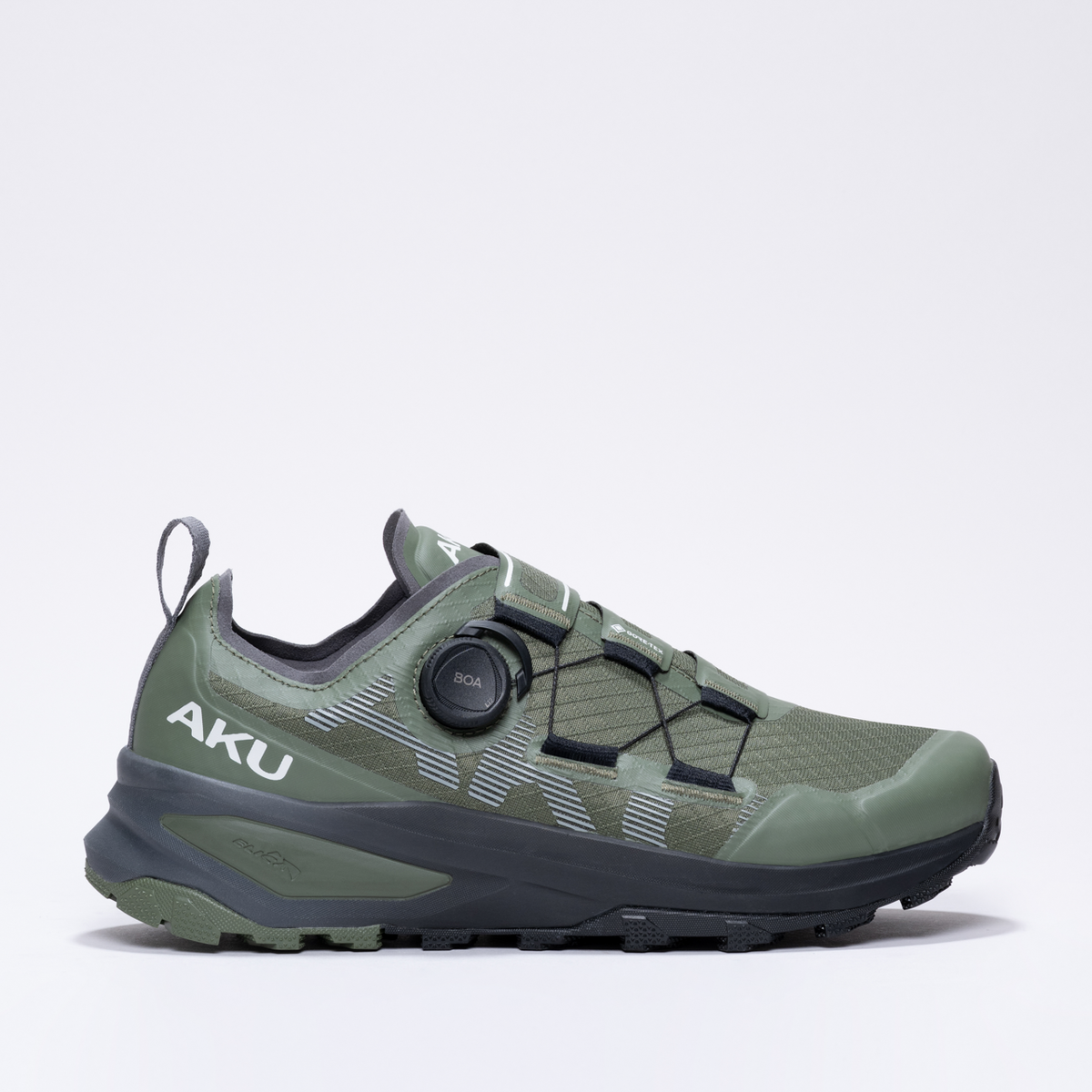
Both use the Gore-Tex Most Breathable membrane — Gore-Tex's lightest, most ventilating waterproof lining, which is exactly what you want when summer mixes wet grass and bog with warm air.
Choose shoes when you are on genuine trails — loose, rocky or wet underfoot — but carrying a day pack and want to move quickly.
Lightweight boots
A lightweight boot is mid-cut: the collar sits above the ankle to add support and keep grit out, but the materials stay modern and light, so you avoid the weight of a traditional leather boot. AKU's Flyrock Mid GTX takes the Flyrock platform and adds a supportive mid-cut collar, at 402 g (men) / 342 g (women) — only around 30 g more than the low-cut Flyrock. The Furiosa BOA Trek GTX pairs the BOA dial with a mid-cut, hiking-tuned build at 475 g (men) / 445 g (women).
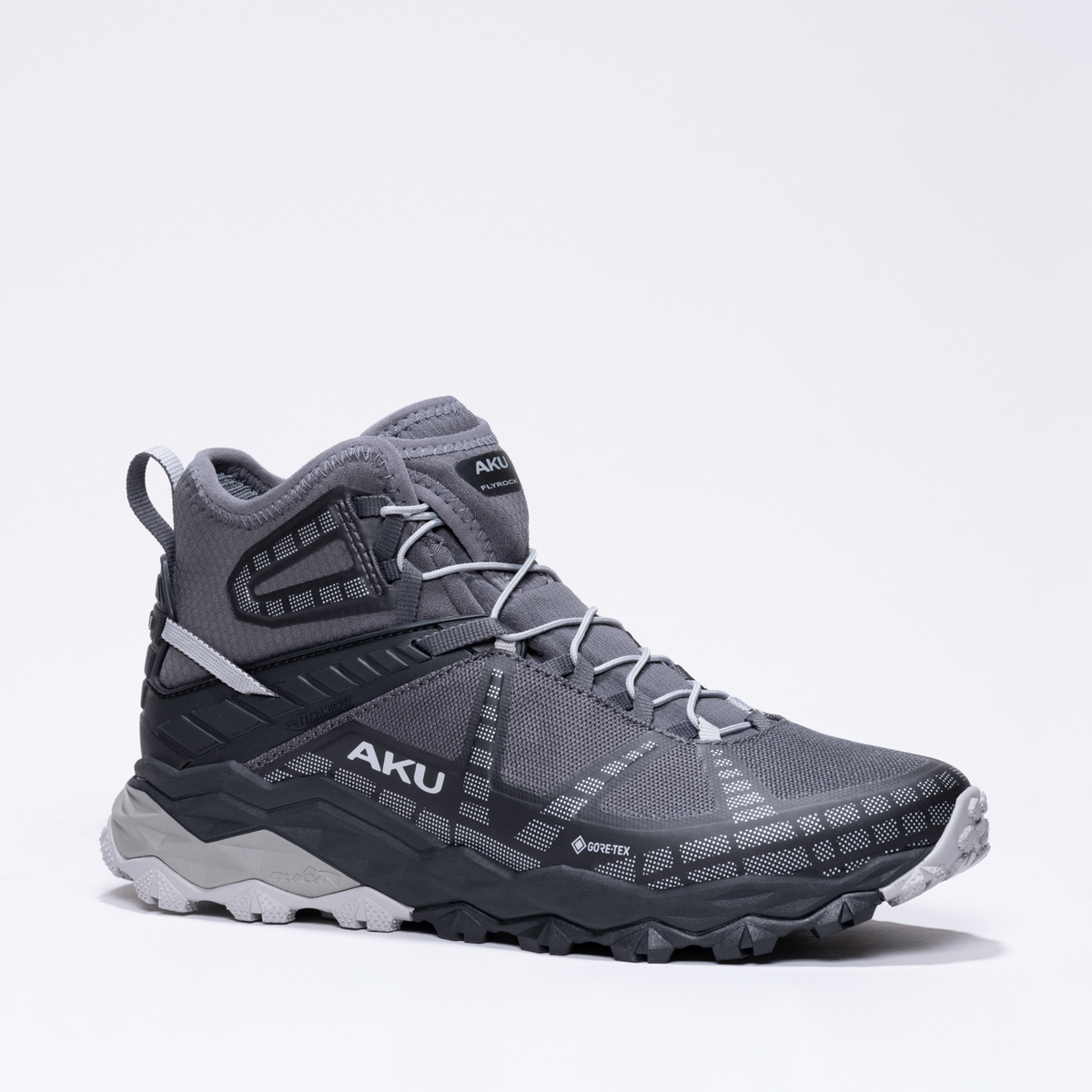
The extra ankle coverage earns its keep on uneven, tussocky or rocky ground, on descents, and when a pack adds load to each step. You still get the Vibram Megagrip outsole and the Gore-Tex Most Breathable lining, so you are not paying for the support with heat.
Choose lightweight boots when the terrain is rough or uneven, the days are long, or you want ankle support and a little more protection without the weight of a full leather boot.
Waterproof or breathable? The real summer question
Most summer regret comes down to one decision: Gore-Tex or not. A waterproof membrane keeps wet grass, bog and afternoon showers out — common on UK hills even in July. The trade-off is a little less airflow. The non-membrane versions breathe more freely and dry faster, which suits genuinely hot, dry spells and abroad.
AKU's summer footwear uses the Gore-Tex Most Breathable membrane specifically because it is the brand's most ventilating waterproof lining — the closest thing to having both. And because AKU controls its own factory, AKU tests the waterproof lining of every Gore-Tex pair individually before it leaves Montebelluna (AKU manufacturing specification), rather than spot-checking batches.
Rule of thumb: if your walk includes wet grass, bog or any chance of rain, keep the Gore-Tex. Only drop to non-membrane shoes for reliably hot, dry trails where breathability is the priority.
How to choose for your summer walk
Work through three questions in order:
- What is underfoot? Even, hard paths → trainers. Loose, rocky or wet trail → shoes. Rough, uneven or steep ground → mid-cut boots.
- How heavy is your load and how long is the day? Light pack, short day → low-cut is fine. Heavier pack or long day → the ankle support of a mid-cut boot pays off.
- Will your feet get wet? Any chance of bog, dew or rain → Gore-Tex. Hot and dry only → non-membrane for airflow.
Fit matters as much as category. AKU shapes its footwear on anatomical lasts and builds in the Elica Natural Stride System to support a natural roll through each step. Sizing runs slightly closer than some British brands, so try your normal size first and size up only if you are between sizes or wearing thicker summer socks. For low-cut shoes, break-in is minimal — a couple of short walks is usually enough.
The trainers-versus-boots debate runs hot every summer on UK hiking communities — threads on Reddit's r/CampingGear and r/WildCamping, and forums such as Walkhighlands, increasingly land on the same answer this guide gives: match the footwear to the terrain and the load, not to habit. Lightweight shoes have won over many UK day hikers for dry summer trails, while mid-cut boots keep their place for rough ground and heavier packs.
Why AKU for summer footwear
AKU has built footwear in Montebelluna, in Italy's historic Veneto bootmaking district, since the company was founded in 1980 by Galliano Bordin (AKU company archives). That heritage shows up in the details that matter over a summer of walking: certified Gore-Tex waterproofing tested pair by pair, Vibram outsoles chosen for grip and durability, anatomical Italian fit, and a build designed to be resoled and repaired rather than thrown away. AKU footwear is stocked and supported in the UK, so sizing help and after-sales are close to hand.
Frequently asked questions
Do I need waterproof hiking shoes in summer?
On UK trails, usually yes. Even in summer, wet grass, morning dew, bog and afternoon showers are common, and a Gore-Tex membrane keeps feet dry without much heat penalty when it is the breathable type AKU uses. Choose non-waterproof shoes only for reliably hot, dry conditions where maximum airflow matters more than staying dry.
Are hiking trainers good enough for hiking?
For easy, well-made trails, towpaths and gentle hills with a light pack, hiking trainers like the AKU Aira V-Light are comfortable and capable. For loose, rocky or wet terrain you want a hiking shoe with a Vibram Megagrip outsole, and for rough ground or heavier loads a mid-cut lightweight boot gives the grip and ankle support a trainer cannot.
What is the difference between hiking shoes and hiking boots?
Cut and support. Hiking shoes are low-cut, sitting below the ankle for low weight and freedom of movement — ideal for fast day hikes. Hiking boots are mid- or high-cut, adding a supportive collar above the ankle for rough ground, descents and loaded packs. Both can share the same outsole and waterproofing; the boot simply adds support and protection at a small weight cost.
What is the lightest AKU hiking shoe for summer?
The AKU Aira V-Light is the lightest, at 275 g per shoe for women and 395 g for men (AKU SS26 product specification). The non-Gore-Tex version is lighter still — 265 g (women) / 385 g (men) — for hot, dry conditions. For more trail grip at low weight, the Flyrock GTX is 300 g (women) / 372 g (men).
Published 23 June 2026 · AKU Academy, aku.co.uk